


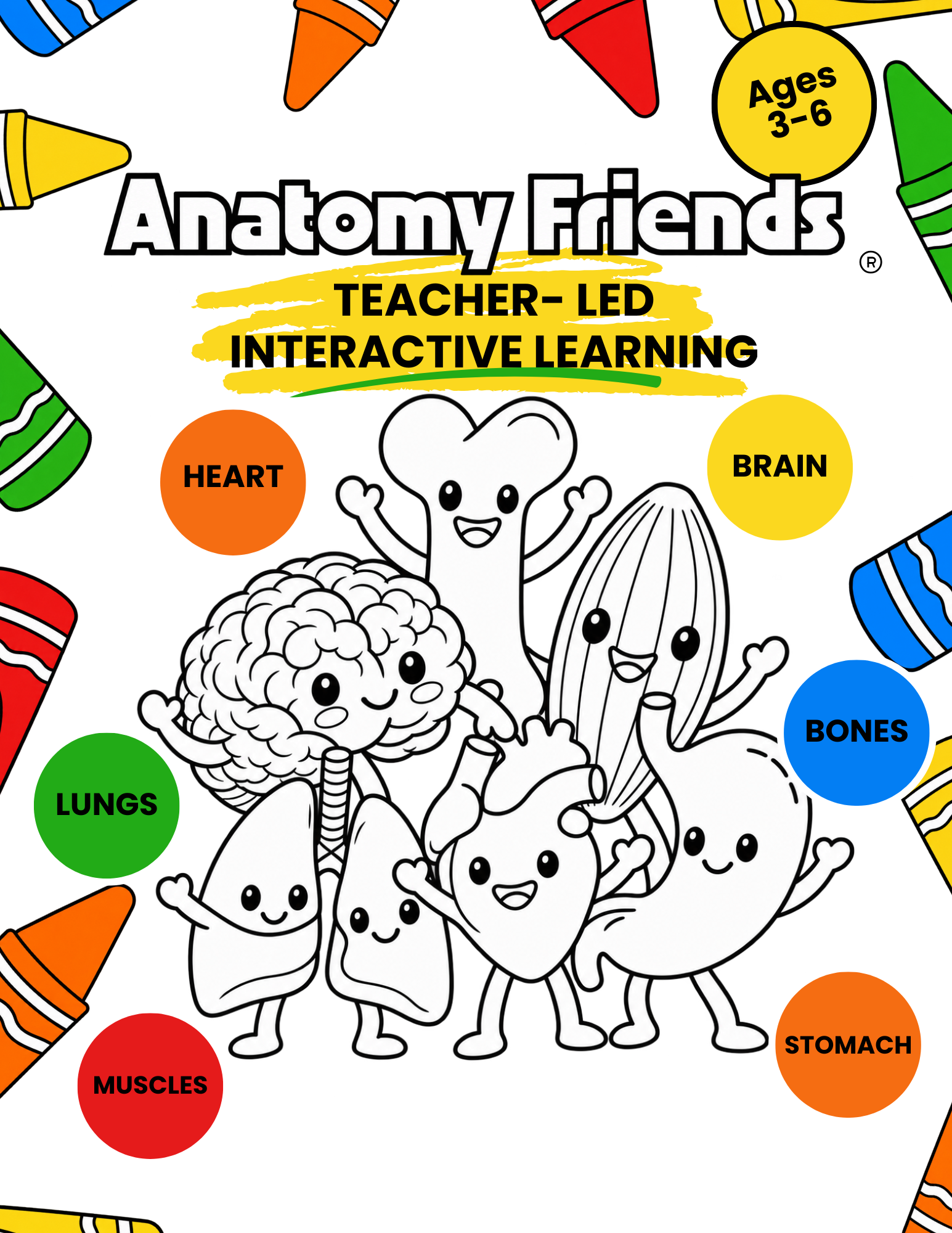

Discover Heart, Brain, Lungs, Bones, Muscles, and Stomach through a guided classroom experience.
Includes:
Teacher-led presentation
Group participation activities
Printable classroom resources
Take-home activities
Anatomy Friends classroom presentations are licensed for use by the purchasing educator. Redistribution, resale, and sharing of presentation files or account credentials are prohibited.
Intended age group | Ages 3–6 |
Learning objectives | By the end of this lesson, students will be encouraged to:
|
Estimated duration | 60mins (time will vary) |
Materials needed | Paper, crayons, pencils, printables, projector or slide show display device |
Teacher guidance | Suggested Teaching Strategies1. Introduce Each Anatomy Friend Present each character individually and encourage students to identify its name. Explain the body part's primary function using simple, age-appropriate language. Invite students to repeat the name and share what they already know. 2. Explore Body Part Locations Encourage students to identify where each featured body part is located. Use anatomical illustrations, body diagrams, or age-appropriate gestures to help students connect the characters to their own bodies. 3. Connect Anatomy to Everyday Activities Help students understand how their bodies work by connecting anatomical concepts to familiar experiences, such as feeling their heartbeat, taking a deep breath, bending their arms, walking, eating, or thinking. 4. Encourage Interactive Participation Pause throughout the presentation to ask questions, invite observations, and encourage students to describe what they see. Allow students to respond verbally, through gestures, or by pointing to illustrations. 5. Demonstrate How Body Parts Work Together Introduce simple connections between body parts. For example, explain how bones and muscles work together to help us move or how the brain sends messages that help control our movements. 6. Reinforce Learning Through Movement Incorporate simple, safe movements when appropriate. Students may stretch their arms, bend their knees, gently feel their heartbeat, or observe their breathing to connect the lesson to their bodies. 7. Review and Reinforce Vocabulary Revisit the six featured body parts throughout the lesson. Encourage students to recall their names, identify their locations, and describe their basic functions using their own words. Suggested Discussion Questions
Instructional FlexibilityEducators may introduce one Anatomy Friend per lesson, combine several characters into a group activity, or present all six as an introductory overview of the human body. Lessons should be adjusted to accommodate students' developmental readiness, attention spans, learning abilities, and classroom schedules. Educator Note: The goal of this presentation is to develop early anatomical awareness, curiosity, and confidence in exploring the human body. Emphasize participation and understanding rather than memorization of complex scientific terminology. |
Accessibility | Anatomy Friends is designed to support engaging, age-appropriate learning for students with diverse abilities and learning styles. Educators are encouraged to adapt lessons and activities to meet the individual needs of their students. Suggested Classroom Accommodations:
Educator Note: Anatomy Friends materials are intended to complement inclusive classroom instruction. Teachers should follow applicable student accommodation plans and school accessibility policies. |
License identification | Single-Educator License Purchase of this Anatomy Friends digital slideshow grants one educator a non-exclusive, non-transferable license to use the presentation for educational instruction. Permitted Use:
Restrictions:
Copyright: © 2026 Anatomy Friends. All Rights Reserved. Please Note: This is a digital product. No physical item will be shipped. Purchase grants a license to use the materials, not ownership of the intellectual property. By purchasing this product, you agree to the applicable Anatomy Friends Digital Product License Terms. |
Support | www.anatomyfriends.com |
